Six ways to spot a fake in 30 seconds
Cyclops. Rehaut. Sweep. Weight. Caseback. Serial.
You will not authenticate a watch properly in half a minute — a real appraisal means movement inspection, papers, provenance and often opening the case. But you can triage one. The six checks below are the fast filters professionals run before anything else. Each takes about five seconds. If a watch fails even one badly, stop and get it in front of a specialist before money changes hands.

1. The Cyclops — look through it, not at it
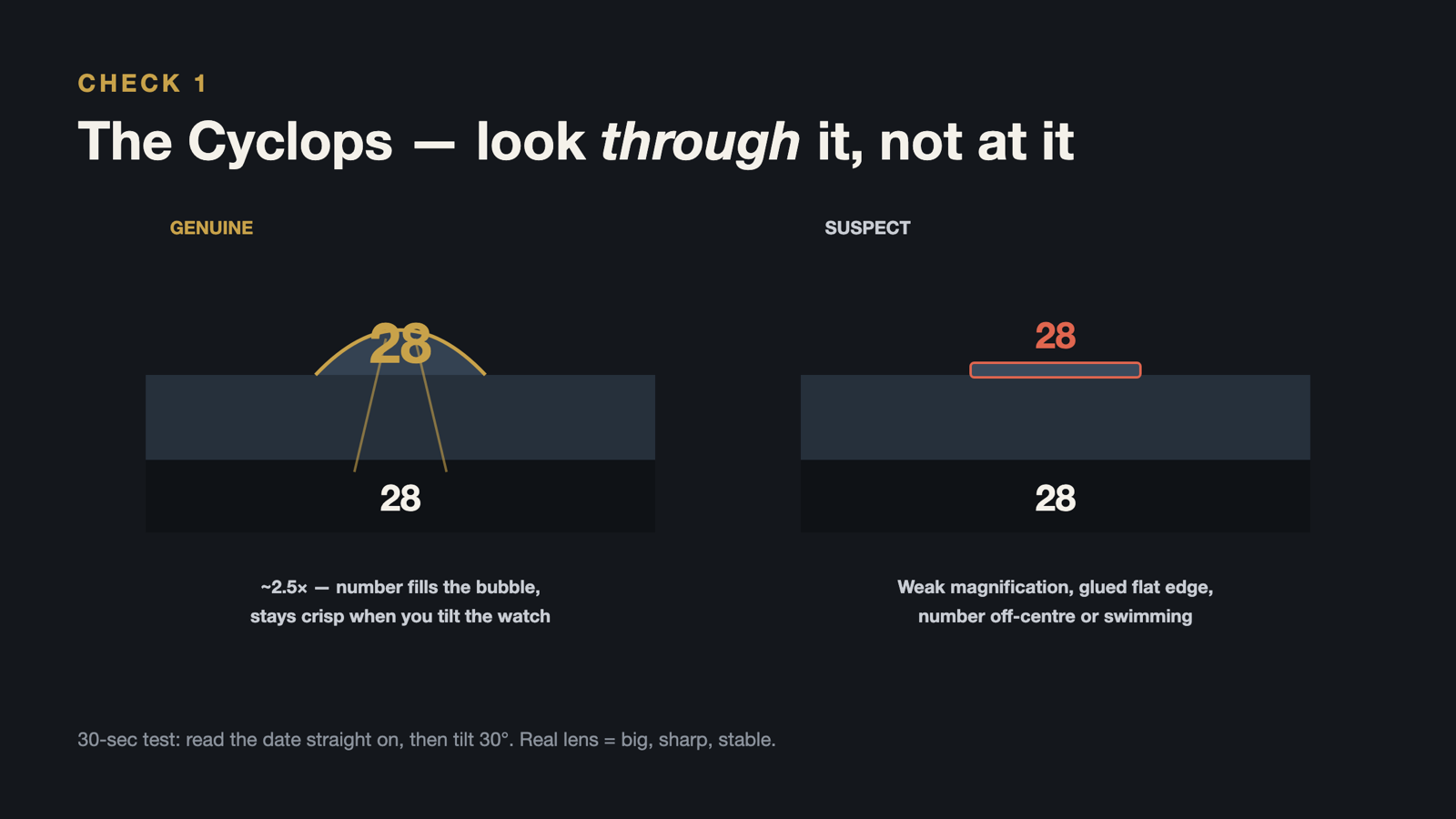
The cyclops is the small magnifying lens set into the crystal over the date window (most associated with Rolex, but copied everywhere). On a genuine watch it is a real optical lens: it magnifies the date roughly 2.5× and the number fills the bubble. Tilt the watch and the date stays readable across the whole lens.
Fast fail signals:
- The date looks barely bigger than the rest of the dial — weak or no magnification.
- The number is off-centre inside the bubble, or swims badly when you tilt the watch.
- The lens sits as a flat sticker or a shallow dome with a visible glued edge.
- On a modern sapphire-crystal Rolex, no faint blue anti-reflective tint under the lens.
30-second version: glance at the date through the bubble from straight on, then tilt 30 degrees. Real lens = big, crisp, stable. Fake = small, smeary, wandering.
2. The Rehaut — read the ring between dial and crystal
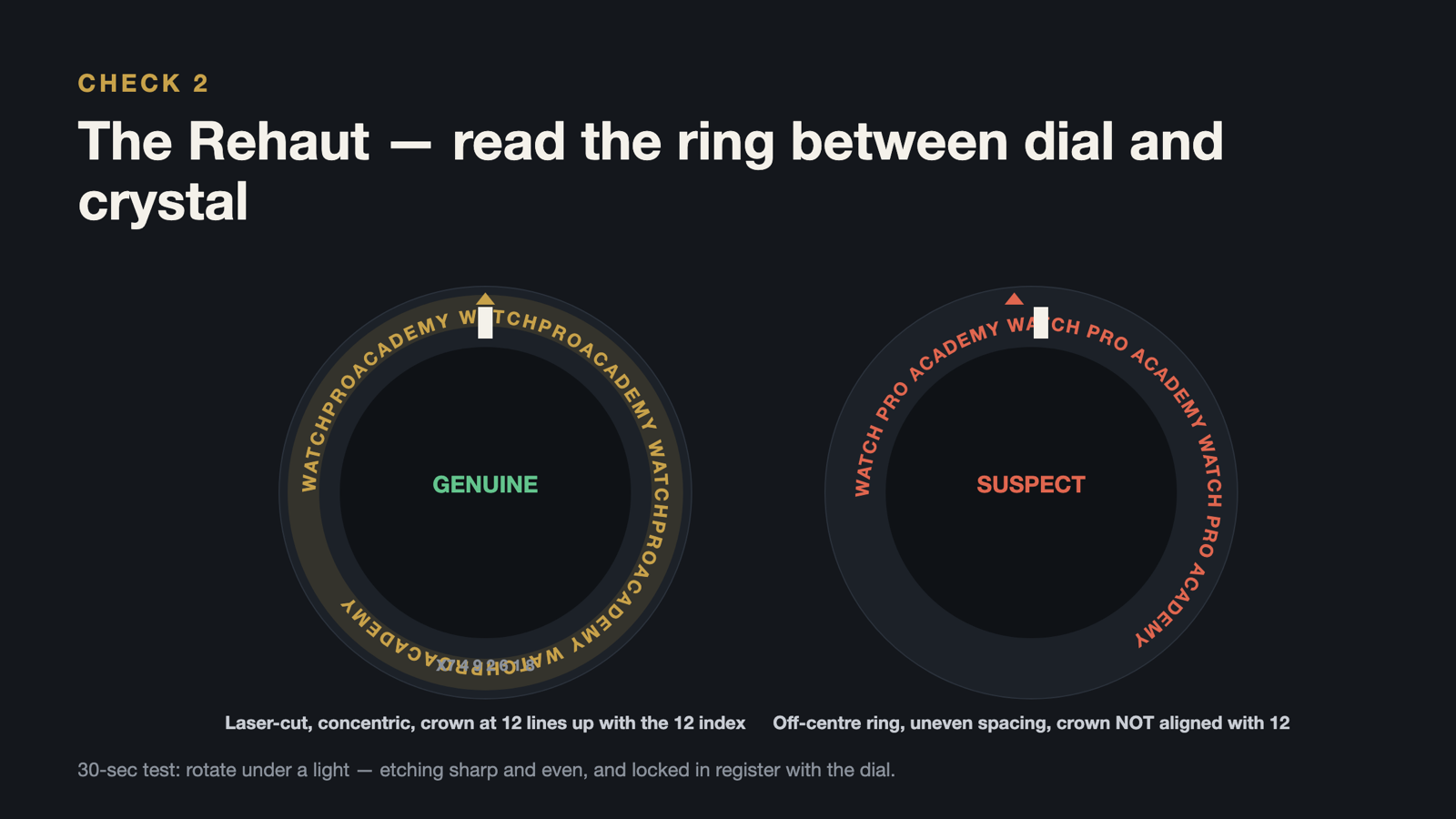
The rehaut (or rehaut flange) is the angled inner ring surrounding the dial. On many modern pieces — Rolex since around 2005 especially — it is laser-etched with the brand name repeated around the circumference, plus a serial number at the 6 o’clock position.
Fast fail signals:
- Engraving that looks printed, painted, or acid-etched and grainy rather than cleanly laser-cut.
- Text that is not perfectly concentric — letters drifting closer to the crystal on one side.
- Rehaut engraving misaligned with the dial markers. On genuine Rolex the crown at 12 lines up precisely with the 12 marker.
- Uneven letter spacing, wrong font weight, or a serial that does not match the one between the lugs.
30-second version: tip the watch under a light and rotate it. The etching should be sharp, even, and locked in register with the dial.
3. The Sweep — watch the seconds hand for five seconds
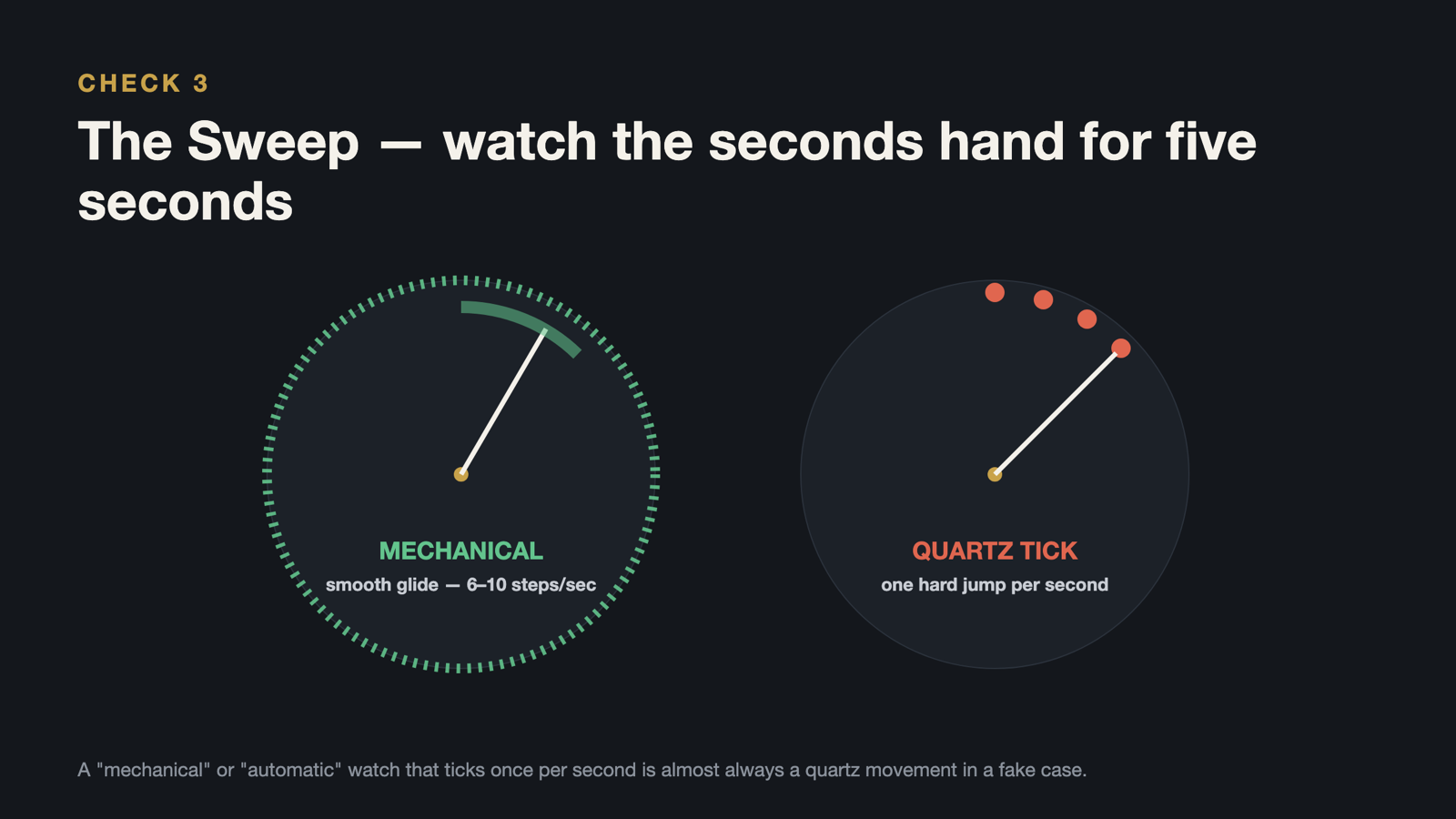
A mechanical watch’s seconds hand sweeps: it moves in many small steps per second (6, 8 or 10 depending on the movement’s beat rate) so the motion looks smooth and gliding. A quartz watch ticks once per second. A cheap fake “automatic” almost always has a quartz movement inside, so it tick-tick-ticks in full one-second jumps.
Fast fail signals:
- One hard tick per second on a watch sold as an automatic or manual mechanical.
- A stuttering, slightly irregular sweep — some replica movements fake a sweep badly and you can see it hesitate.
- The seconds hand not hitting the minute markers cleanly.
Caveat: some genuine mechanicals (Grand Seiko Spring Drive, Bulova Precisionist) have their own distinctive sweeps, and genuine quartz watches obviously tick. Judge the sweep against what the watch claims to be.
4. The Weight — pick it up with your eyes closed
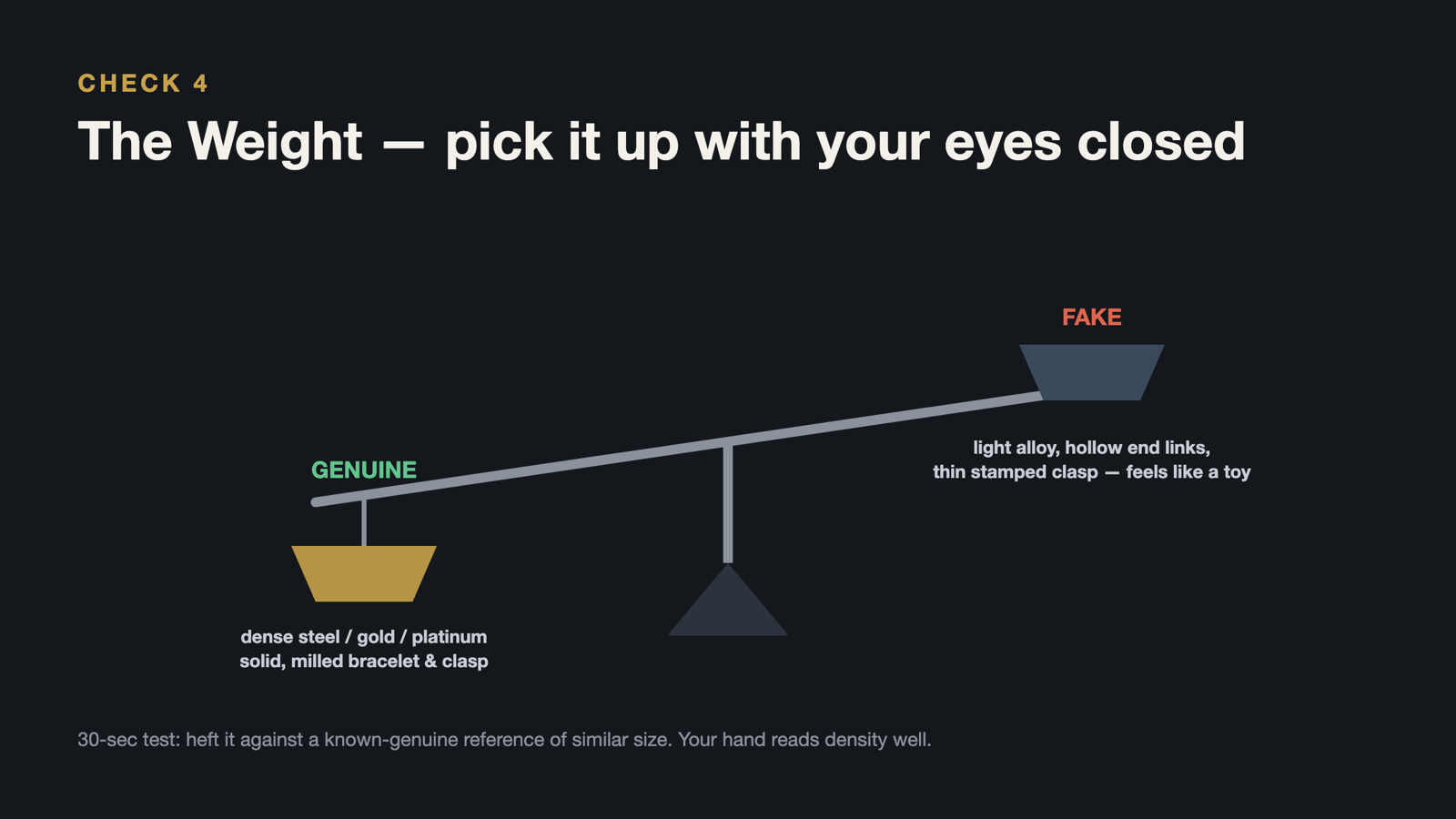
Precious metals and quality steel are dense. Genuine luxury watches in 904L/316L steel, gold or platinum have a specific, reassuring heft and the weight is balanced between case and bracelet. Counterfeits often use lighter alloys, hollow end links and stamped clasps, so they feel toy-like — or, occasionally, wrongly heavy with a dead, cheap-metal feel.
Fast fail signals:
- The watch feels conspicuously light for its size and the metal it claims to be.
- The bracelet feels hollow and rattly; links collapse loosely; the clasp is thin and stamped rather than milled.
- Weight distribution is off — a heavy head on a flimsy bracelet, or vice versa.
- Solid-gold claims on something that feels like plated brass.
30-second version: heft it, then heft a known-genuine reference of similar size. Your hand knows density better than you think.
5. The Caseback — most steel sports watches are plain
Know the reference. A huge number of counterfeits get the caseback wrong because the factory wants it to “look luxurious.”
Fast fail signals:
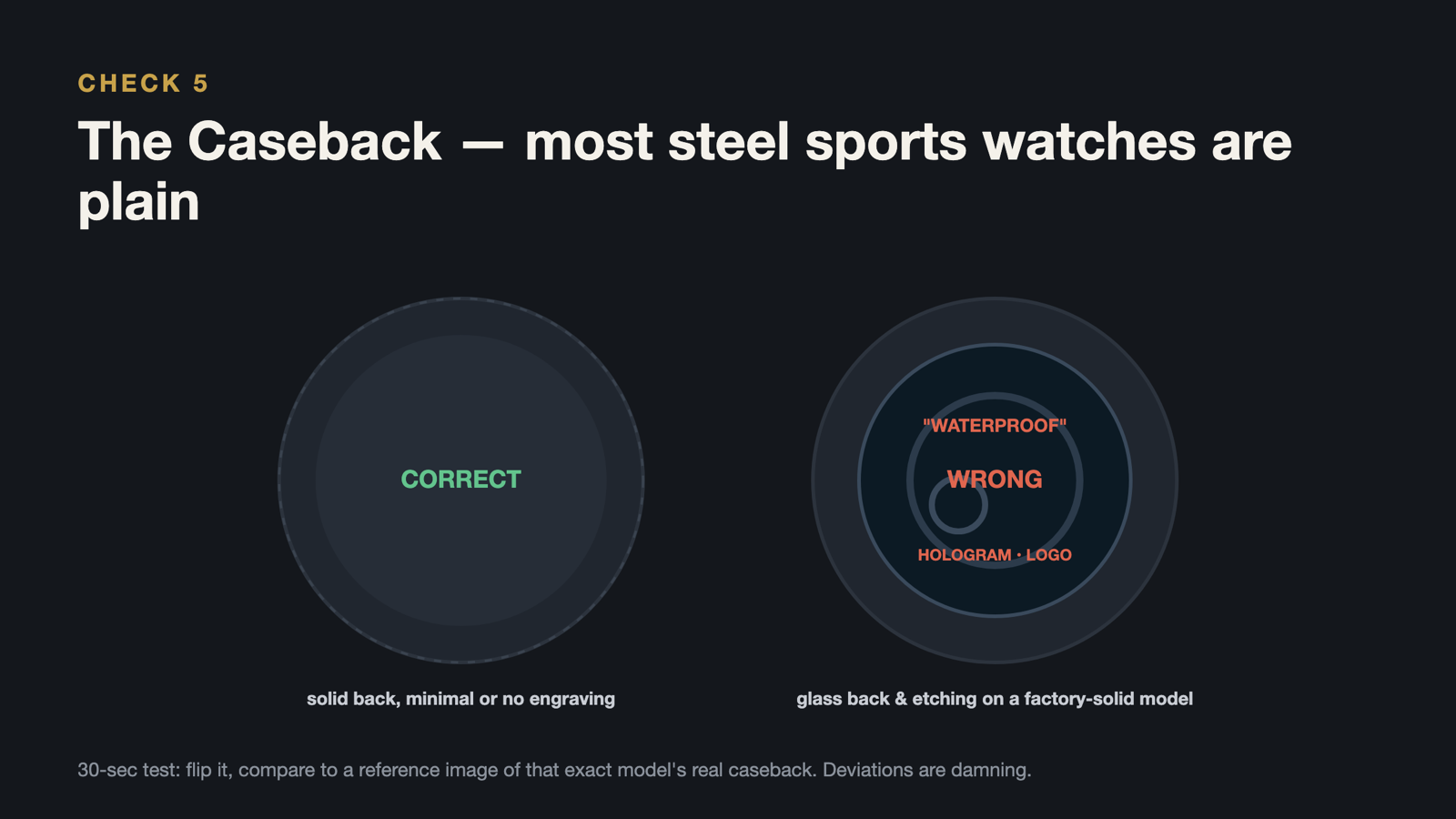
- A display (glass) caseback on a model that is factory-solid. Most steel Rolex sports models have never had an exhibition back — a see-through back on a “Submariner” is an instant fail.
- Engraved logos, model pictures, “waterproof” claims, holograms or elaborate etching on a model that should have a clean, minimally marked back.
- Crooked, shallow, or gritty engraving; wrong font; misspelled text.
- Stickers left on to imply newness, covering a back that does not match the reference.
30-second version: flip it over. Compare against a reference image of that exact model’s real caseback. Deviations are damning.
6. The Serial — check it exists, matches, and is cut right
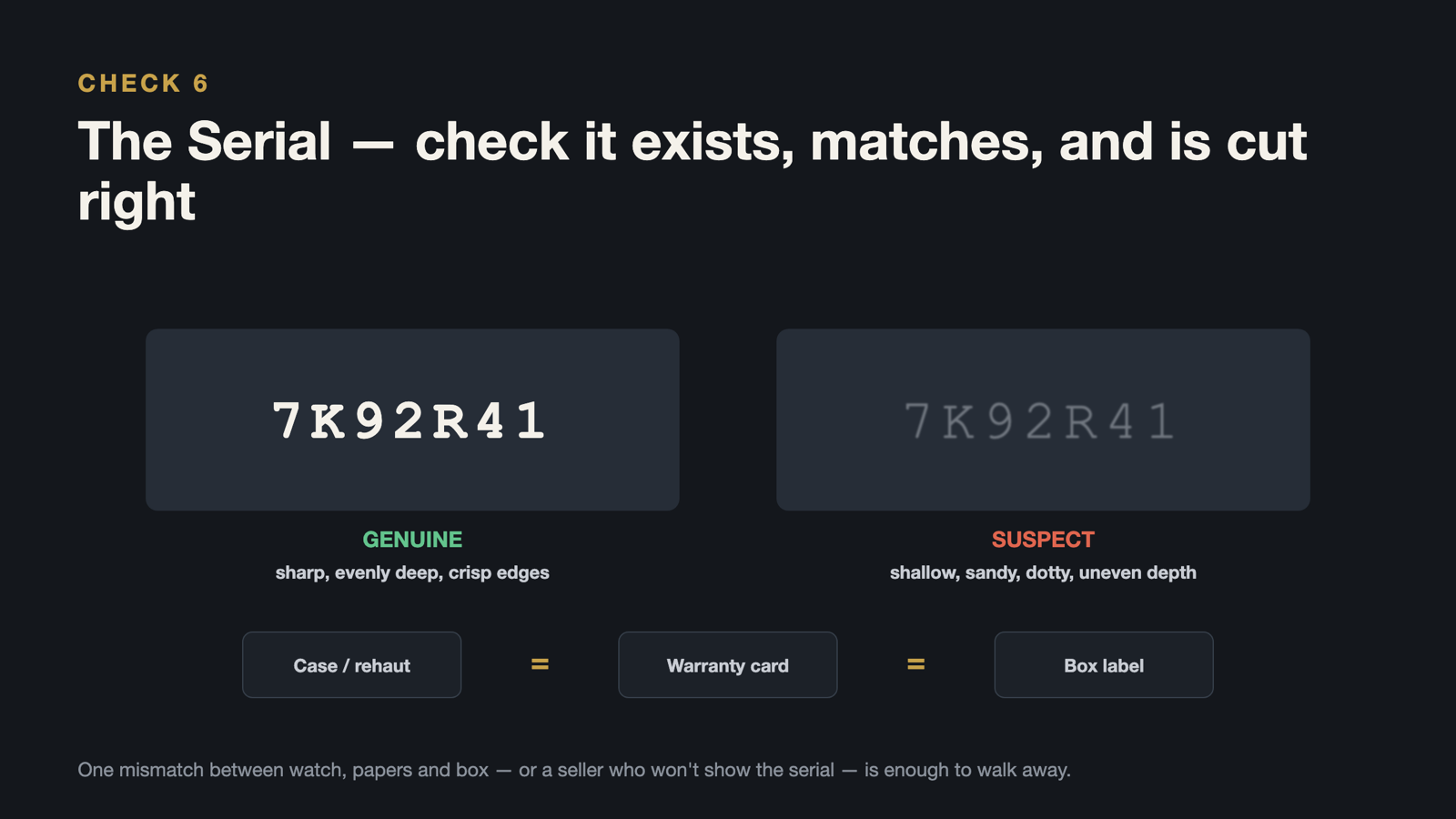
Serial and model numbers live in known places for each brand: between the lugs (older Rolex), on the rehaut (newer Rolex), on the caseback, or on the papers and warranty card. They should be crisp, consistent with each other, and appropriate for the claimed production year.
Fast fail signals:
- Numbers that are shallow, sandy, dotty, or unevenly deep — genuine modern engraving is sharp and cleanly cut.
- Serial on the case not matching the serial on the rehaut, the card, or the box.
- A serial that decodes to the wrong production period for the design of the watch.
- Font, character spacing or placement that does not match brand references.
- Card, box and papers with mismatched fonts or poor print registration.
- A seller who will not let you see the serial at all.
30-second version: find the serial, photograph it, and check it against the papers and a reference for that brand and era. One mismatch is enough to walk away.
The 30-second routine, in order
- Sweep — stare at the seconds hand (5s)
- Cyclops — date through the bubble, straight on then tilted (5s)
- Rehaut — rotate under light, check the etching and alignment (5s)
- Caseback — flip, compare to a known reference (5s)
- Weight — heft it against a genuine reference (5s)
- Serial — locate it, check it matches the papers (5s)
Pass all six and the watch has earned a proper inspection — not a clean bill of health. Fail one clearly and you have saved yourself a very expensive mistake. When in doubt, buy the seller’s reputation and paperwork before you buy the watch, and have anything significant authenticated by a specialist or the manufacturer.